The conversation below is an effort to blur the boundaries of my online course to expose my students to the world “outside” the walls of our online course, and to invite the world “in” to our course to enhance our current discussion on how to engage online learners. This activity also serves as an example and model of an activity i am using to “engage” my own online students in this course.
I learned to not be afraid of trying things on the computer, that the computer is not going to break or all things lost. I remember how awesome it was to realize that i could text code online docs through diigo. I remember how long it took me to figure out what a tag was and how to do it. Although, I still can’t say I know how to use them. And you know what? I don’t care! Setting up accounts on Voicethreads and edublogs was crazy to me. I didn’t know that i could do that. I felt scared and now I feel empowered. I think I can give myself some credit but, alex has been an amazing facilitator. Her feedback has been gentle yet, demanding that i meet high expectations.
It occurred to me that real learning requires the removal of classroom walls in the sense that students need to be made to feel empowered in their ability to learn independently, as well as in the amount of information they learn. This realization was triggered after reading Alex’s blog about her recent NUTN conference. In her entries she talks about the use of Twitter and other Web 2.0 technologies in the online classroom. My initial thoughts were that teaching online was, of itself, enough of a technological integration for students to expand their thinking. But I now believe that the online environment, while substantially more engaging to me than a f2f classroom, can still leave one – at the end of the course – with novel ideas and knowledge gained through exchange with only a handful of students, an instructor, and a few texts. Now I understand why Alex is so interested in the integration of other web 2.0 technologies into the online environment. Suddenly, the student is propelled to think clearly and critically, as now their core ideas have the potential to be shared with anyone, anywhere.
From Alex (A series of Unfortunate Online Events and How to Avoid Them) , I learned an incredible amount of invaluable information that gave me a broadened perspective from the viewpoint of a student as well as a teacher. …When all is said and done, this was a fantastic learning experience. Thank you, Alex!
One thing I’ve learned through the example of Alex, is the importance of reaching out and engaging students on a personal level.
Thank you for everything, Alex! I have learned so much from you that goes beyond the technical aspect of teaching online – I learned how think about my teaching (f2f as well as online) in a more holistic way. I think, for the first time, I learned how to teach. I am not even sure how you accomplished that, because it was not done in an overt manner. But anyway, thank you. I am so glad that I came back this summer and finally got to finish your course!
I think Alex is an amazing teacher who is supportive and nurturing. She is a Master teacher in Social and teaching presence. Her encouragement when I was ready to throw in the towel was a blessing. I learned so much from Alex that it is hard to be specific. I learned from Alex just how important as an instructor to have established an on-line community and how to be there for a student(s). I will take this away with me from this course and pass it forward to someone else who struggles and loses their confidence.
This module has given me support for my current online teaching and reinforced my thinking about the value and necessity of online education. I have also come to realize how fortunate we are as a class community to have Alex guiding us through this process. I am constantly amazed at the professional contributions she has made to the field. Specifically in the development of quality online instructors and the creation of standards and models for online classes.
I really like how Alex has created a welcoming environment in our course and I hope I have done the same in mind. I feel very comfortable in our classroom and am not afraid to ask a question. Classroom community is very, very important in an online course as all of the interaction takes place behind a computer screen unlike a traditional classroom where it takes place in a face to face setting.
I have enjoyed communicating with Alex on Seesmic. It has been fun and Alex has been really helpful in brainstorming and conducting research on how I can incorporate this software into my course. After chatting with her a few times, I have decided to add Seesmic to my course as one of my learning activities. I am going to add this into the module on Preparing for the Interview. I am going to have students generate questions and practice role playing with each other. It will allow students to be able to respond at their (but keeping it within the timeframe), communicate with students in another form of communication, and allow them to gain experience as being an interviewer/interviewee.
I hope to create a learning environment that is warm and inviting. Once again, I have been in a classroom setting where I felt like I was out there all by myself. I did not like the way this felt and I don’t want my students to feel this way either. Seeing that I have been in their shoes, I know what they are going through. A positive, caring personality sets the tone for the course (I have to say Alex has done this in this course).
Alex’s presentation started off with a YouTube video demonstrating passion and joy….the things she feels for learning. She is an inspiration to educators hoping to find the best of both the world of emerging technological advances on the web and the world of student learning outcomes. She also showed me (for the first time) how many tools are available for us to use:
Alex, my instructor, has referred to our courses as living, breathing things that are always growing and changing. I realize now that courses not only change each time they run, but that it’s okay for them to change while the course is running.
Alex’s feedback to us on our course profiles, discussions and blogs have been great because they are very specific; offering encouragement and support while at the same time demanding more and telling us exactly what to correct and why. That kind of feedback is appreciated because I know where I stand in the course, and I know where I need to improve and how I can improve. It’s not enough to tell students they are wrong, the real learning takes place when students know why they are wrong and how they can fix it!
just watched alex’s clip on us; wow, we built community through a computer! i love you guys and will miss all this rigour and interaction. time to move on. school year is approaching-may we all change the world!
This learning experience has been intense! I know that I have learned, for god’s sake I created an online course! I think about the insecure me 3 months ago, so afraid to be pushed out of my learning comfort zone. Alex and my peers, pushed me and I waded out there, well, it was actually like tredding for dear life.
Alex taught us a lot but also asked a lot of us. The work load was ridiculous at times and it seems like we did some things just for the sake of doing them. Nevertheless, the course was worthwhile and I’d recommend it – Just be willing to work really hard.
8/14/09
ETAP687
1
5
4
3
One of the best teachers I’ve ever had. hard as heck, though.
8/7/09
ETAP687
1
5
5
4
Alex is an amazing teacher.I will strive professionally to be more like her and to achieve because she has inspired me to do so.
8/7/09
ETAP687
3
5
5
5
This course was extremely helpful, I learned so much. The course has helped me stay current in my field both for school and in my career. I am one up on others by taking this course. Technology changes every day and it is hard to stay on-top of new products/software. Alex is a fantastic teacher who is very dedicated and Very Very good in her field.
8/6/09
ETAP687
2
5
5
4
Course required a lot of time invested in work (developing our own online classes) but Alex was very supportive and always available! learned a lot!
8/5/09
ETAP687
1
5
4
5
Alex is a wonderful, approachable person and a fantastic teacher! Yes, the course was hard, but she did not – at any time- present us with a challenge that we could not meet. If you are interested in online education, you should not miss this course!
8/4/09
ETAP689
1
5
5
4
Great experience. Hard work, but well worth it. Alex is one of a kind. Would recommend it to anyone serious about quality online course delivery.
This is a presentation on my online course ETAP687 using a tool called prezi. You can also view it from here.
To activate the presentation, just click on the arrow in the center of the screen (you may need to wait a little while it loads). To advance through the presentation, use the forward arrow that appears on the lower right corner of the screen.
The ability to embed the prezi in a blog is new – just announced yesterday. So i am testing it here.
One of my current students uses her dog, Bishop, as her profile image. I love that she does that. It gives me a warm feeling about her. She mentioned in one of our discussions that she chose him because she was concerned about her privacy and security.
She said:
I think it is funny that you mention my use of my Bishop for an image. I had a reason. In a class we had on cyber security, it said to never use a real image of yourself unless you want it broadcasted. We learned how to build an Avatar. I do not like my Avatar because when I made it, the selections did not include large or handicapped people as a choice. Everything was “beautiful people” and personally, I think that is very wrong. I have never gone out there to look further to see if there are other places (I used Yahoo) to see if you can build a real person. So I chose Bishop as he is my familiar.
As soon as i read her post i did a google search and started playing with 2D avatar generators to see what i could come up with. Below are links to the ones i found an played with. The resulting images i have inserted in to this post.
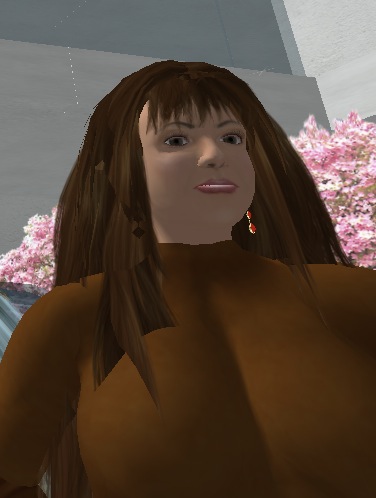
These last 2 are my SecondLife 3D avatars. I lived in my newbie SL skin (left) for almost a year before changing her to a more “realistic” me (right) : ) Not sure why, but i never messed with her looks much till i saw someone walk by that looked just like me, and then i started thinking about it and wanted her to look more like the real me, so i plumped her up and got some “good” hair to look more like mine. Then i didn’t touch her looks again till i had to do a presentation in SL (https://etap687.edublogs.org/secondlife-if-my-avatar-could-talk/) and wanted to represent myself more realistically and less like a newbie. Have not really touched her since… i had a hard time finding appropriate clothes. I think about the online representation of self often. Colleagues and i have talked about, especially in the hyper-sexualized world of secondlife. I note it everytime i log into some place on the social web and see how friends and colleagues choose to represent themselves, or when i am required to upload yet another image to another profile somewhere… I am charmed by those who choose animals or some image that whispers insight into the person. I like that invention and creativity very much. None of the new little avatars i generated “really” look like me. There is a suggestion of me, i suppose. Brown skin, hair, and eyes. long curly hair… i really like the little one with the black skirt and shirt, but i will not be running around the web changing my profile images to any of these anytime soon.
I understand and respect the need for privacy, and for some, not wanting one’s “real” image floating about the net. For some there may be a sense of loss of control. I guess i feel “in charge” of what i put out there.
i am using gcast (the widget below) to give you access to your podcasted audio feedback to your module 3 written assignment. (You can also access your feedback here: http://www.gcast.com/u/alexandrapickett/main). I have done a separate individualized podcast for each of you labeled with your name. Feel free to listen to each other’s podcasts.
You may only see one post listed in the widget below. If so, to see the whole playlist from which you can select your individualized podcast click on the word “posts” in the lower center of the widget. This will bring up the entire playlist from which you can choose the one that belongs to you.
Please let me know if you have any problems accessing this feedback.
I posted these links to feedback on your course built it activities in the gradebook, but i don’t know/ am not sure that you can see them there/have seen them there, so here they are.
I encourage you to have a look at each other’s feedback. At this stage in your course development most of my feedback is applicable to any course, some is repetative, and you may find excellent suggestions to apply to your own course that may not have come up in my review of your course at this time. They are jing screencasts and each are only 5 minutes long at most.
Last year i was invited to participate in a planning meeting for the 2009 annual conference of the National University Telecommunications Network (NUTN) by Joanne Humbert from RIT from the planning committee. The 27th annual NUTN 2009: Quality In Motion conference, was held on June 21-23, 3009 in Saratoga Springs, NY. The conference started on Sunday, but we didn’t get home till 2am due to flight delays so i slept all of Sunday. I am sorry I missed Ed Bowen’s keynote address Sunday night. I heard that it was great and that he looked very dapper in his tux. : ) I know Ed becuase he was a participant in my workshop last year at the Sloan-C ALN conference and we have become social web “friends” since. The conference started on Monday with Elliott Maisie’s plenary address. He only had one slide. Elliot uses his smart phone as a cognitive prosthetic – i particularly liked the restroom finder app. that he recommends.He is an excellent speaker.
The presentation was fantastic! I felt like a rock star. I LOVE doing this presentation!! Ed Bowen introduced me and did a wonderful job. He was very kind!
I spent the next hour and a half after my presentation being interviewed by Ed. We had a great conversation and i really enjoyed our time, even if i missed the Edupunk presentation.
Conference
Highlights from some of the sessions i attended:
It was wonderful to see Frank Mayadas and to listen to his keynote address.
The National University Telecommunications Network (NUTN) Distance Education Innovation Award for 2009 was presented to Alexandra M. Pickett and the SUNY Learning Network on June 23, 2009 in Saratoga Springs, NY at the NUTN annual conference(
This award recognizes an individual or group that has developed an innovative program or practice that contributes to the field of distance education, in the context of a new or ongoing program, student or support services, pedagogy, faculty development and support or technology.
The SLN online teaching self-assessment is a simple survey (
http://sln.suny.edu/teachingsurvey), the innovation lies in the report that it generates to the faculty that aids the experienced online instructor to identify areas in his/her course that they themselves feel might need improvement . The results can then be used independently by the instructor to complete the review and revision cycle of the course design process to update the online course in preparation for the next delivery, or it can be used as a component of a faculty development event, or one on one with an instructional designer to pinpoint areas in a course that could be improved, thereby giving the instructor, the trainer, or the instructional designer specific areas on which to focus recommendations, suggestions, examples, tips for improvement.
This survey for experienced online faculty turns theory into practice by assisting the experienced online instructor’s to self-assess on specific indicators of teaching presence from the COI model and on the development of online class community in the design of his/her own online course and how they teach it. Faculty are asked to self-assess on 20 specific indicators, the survey generates a report giving the instructor a numerical score for each indicator that corresponds to a key of range of scores. The instructor can then see, based on his/her own self-evaluation, what specific areas in the online course need (1) redesign, (2) need some improvement, or (3) effectively demonstrate class community and teaching presence and need no improvement. A companion piece to the survey are the handouts (
(I created the this video (with jing, and prezi, and audacity, and other tools) for the acceptance ceremony and it was one of the most time consuming and funnest projects i have ever worked on. I got to learn and do stuff i had never done before. It was a blast creating it.)
One conference down, 2 to go! The drive from Monterey to San Francisco along the coast on US Rt 1 is amazing! It is not a long drive. We took our time. explored. stopped. took pictures. it was great. Getting to the conference hotel was easy, everything went smoothly. I love San Francisco. I was really looking forward to doing my presentation at the Sloan-C emerging technologies conference, June 17-19, 2009, and to the conference itself. Because it is a Sloan event, i knew i will see a lot of people i know. Because it is a new conference, i anticipated that i would meet a lot of people i don’t know. I have been eager to plug into some new communities, and the symposium did not disappoint. One of the very cool things they did was to partner the symposium with a MoodleMoot. A very smart business decision in this economic climate and a very cool way to infuse new blood/energy/enthusiasm into an organization. This is only the second year of the #sloancsym and when i heard they went from 200 participants last year (i did not attend) to over 600 this year, i was astounded and very glad for the organization. I was also thrilled that my presentation “twitterpated with twitter and other web 2.0 technologies for instructional purposes” was selected as the “best in track” session for the Pedagogy and New Learning Environments track. This was one of the motivations i had to rename, revise, and redesign my presentation in a new zooming prezentation tool called prezi that i have been playing with for sometime. So, i delivered a session-length version of my teaching outside the “box” presentation, which i had just delivered as a 3.5 hour workshop to a small audience at the NMC summer conference, in Monterey. The presentation was recorded. Here is the link complete with screen shots – a very high quality video recording – nicely done! I LOVED doing the presentation. There were at least 150 people in the room, maybe more. it was packed! I love an audience and i love sharing and talking about my passion: teaching and learning online. It was also nice to see several friends in the audience including Karen Vignare in the front row, and Burks Oakley. My friend Phil Ice was my facilitator. It was wonderful!
Preconference WorkshopNotes
I wanted to do a preconference workshop and couldn’t decide which. In the end, I opted for the Learning How to Use Google Apps workshop (which i was way interested in) instead of the Moodle 1.9 gradebook workshop(which i way needed). The workshop facilitated by Susan Cline, and Matt Albert from PressPlaySolutions turned out to be a great choice for a good overview of google apps. my takeaways from the workshop:
These are some of the symposium sessions i attended:
Will web 3.0 make us change the way we educate? a call for a new learning management program by Matt Crosslin and Harriet Watkins, University of Texas at Arlington.
They did a cool demo with playdoh and sticking a phone, a pen, a marker, a notepad into the playdoh ball and then switching the tools out quickly/easily.
it was a very effective illustration of Small Pieces Loosely Joined.
Implementing an Online Learning Model in a Social Media World by Thomas Glover and Stacey Ludwig from WGU and Sarah Robbins.
Unfortunately Intellagirl wuz not there : ( but i got a good overview of WGU and their use of social media from Stacey.
Highlight was seeing an @micala tweet in my steam and realizing she was in the room with me and finding her actually sitting in my row !
@hollyrae was also in the room, but did not actually meet her f2f till later.
Into the Third Dimension with SLOODLE by Jeremy Kemp, from San José State University I wanted to see Jeremy and hear what was going on with SLOODLE. He spoke of SLOODLE providing opportunities for engagement, immersion, and scaffolded learning. He showed cool moodle blocks in SL that you can walk around in in secondlife and interact with. He also showed how it interacted in the same way with ANGEL. Still not sure i understand how it all works. VERY COOL! my takeaways from the session:
Still not sure i understand how it all works. But it was VERY COOL!
Using the COI framework to Assess the Efficacy of New Technologies by Phil Ice and Jason Dom from the American Public University System. I was really looking forward to meeting Phil Ice for the first time in person, though we have known each other for a long time. We may have met before, not sure. His presentation was fantastic! It was nice to hear about the COI research that Peter is contributing SLN data to from someone else and to learn about Phil’s particular contribution and findings/results with audio feedback. I immediately started using more audio/video in my live summer course. : ) You must view this slide show now! This was a fantastic presentation with lots stuff information.
tewart Mader – founder of Future Changes, a specialist consultancy that teaches people at Fortune 500 companies, universities, non-profits, and small businesses how to improve productivity using wikis (i.e., Confluence) http://futurechanges.org/
Adrian Wilson – Director of Educational Outreach and Chair of the Microsoft Higher Ed Consortium, chair of the Microsoft Higher Ed Consortium
Guess which two were the coolest?
Virtual Classrooms by John Schuman – education solutions architect, adobe systems. According to John, cloud computing isstyle of computing in which dynamically scalable & often virtualized resource are provided as a service on the net. Things are moving to the clouds, and devices are shrinking as a result. Enter software as a service. . . my takeaways from this session:
https://buzzword.acrobat.com/#o– tentative qualitative data explains that younger students likened document editor to a wiki – a collaborative tool.
Beyond Google: easy to use innovative resource and alternative search engines you can use today by Ray Schroeder, university of illinois at Springfield and Maureen Yoder from Lesley University. Watch this pesentation now! it was fantastic!! i learned stuff i did not know! My takeaways from this session:
Fostering New Learning Communities, Nurturing Online Learning Ecosystems, by Holly Rae Bemis-Schurtz and Susan Bussmann, NMSU/RETA I had no internet access @hollyrae ‘s prezo, but it was fantastic! my takeaway from this session:
Institutional and system barriers to improving student success through technology – is there any reason for hope? by Josh Jarret, senior program officer, special initiatives, Bill and Melinda Gates Foundation. my notes from this session: Began by listening to some shameful stats on how we are failing to educate low-income and students of color. He challenges us to stop what we are doing, be outraged and do something different becuase it is NOT working! He asks how do we address the challenge of completion? what are the solutions? – socialnetworks, limited choice, linked to real-world goal. Compresed classroom time and terms, soft skills development, and career matching, integrated supports and active case management. Blended learning is effective for nontraditional students, social networks, proam networks, adaptive software, intuitive media. Use of simulation roleplay, new assessments. Mentioned excelsior, wgu, kaplan, ria slado… wow!iron triangle: cost, quality, and access – affect one has negative impact on one of the others… according to college presidents. nothing can change if this is true. are we trapped in this iron triangle? Innovation that challenges the status quo dies. so what are the barriers to innovation? He proposes a revolution from within – says we are the soldiers – that evolution will take too long – love it : )
RT @m2sE: the revolution won’t be televised, it’s tweeted : )
This was a fantastically provocative session by a smart articulate man. Every one should watch it now!
Roughly half of students who attempt postsecondary fail to complete a degree or credential – and that number is even higher for low-income students and students of color. Learning technologies are creating dynamic, engaging, and personalized educational experiences with proven effectiveness – yet they rarely go to scale. This conversation will attempt to identify the combination of systemic factors that have consistently resisted transforming learning experiences for students to increase their success – and to ask what if anything can we do to change this reality?
highlights of the symposium for me were:
Moodle not being down during my presentation. MoodleRooms was down for the morning and was thrilled that it came back up in time for my presentation!! that was quite a scare.
Meeting @jjjohnson01, who was in my Sloan-C workshop several years ago! I LOVED meeting him.
Meeting @rrusso and @hollyrae – I had sent out a tweet plea for someone to help me with my MOODLE gradebook (which was a mess after an unexpected upgrade) and two people i had never met that were at the conference tweeted back offering to help. One of them being the guy that led the gradebook preconf workshop! We connected and he helped me figure out how to have moodle add the scores of my discussion ratings. I can’t believe it works! I had been adding it all up manually taking hours and hours and hours. I am so greatful for their help.
Saw several ESC friends – Evelyn Ting and Nicola Martinez. Jon Rubin from Purchase was also there.
felt like @clarkshahnelson was with me at the conference. He also offered to help me with my gradebook and was participating virtually and twittering the session he viewed remotely. very cool.
I met a guy at lunch from New Zealand and asked if he new Terry Neale… AND HE DID!!
I found out later that Claudia Linden was there – i did not see her. I would have loved to talk with her. I saw Gary Miller briefly and wish i had had time to catch up with him more.
Personal highlights were my daughter and brother being with me. We visited the aquarium, went to the Muir woods, had dinner in Sausalito, had a ferry ride across the bay and numerous trolley rides, toured SF in a horse-drawn carriage, had dinners at the Hard Rock Café and the Rain Forest Café – had a wonderful time. The only thing i did not like about this conference was the hotel – no pool, meeting rooms were hot, stuffy, small, and uncomfortable with laptops, not to mention lack of power to plugin. There was no wireless access in some of the meeting rooms, there were fake movable walls between session rooms – and you could hear everything in the other rooms – distracting, plus a number of other small irritations that added up.
I love Monterey, California. AND i loved the New Media Consortium summer conference (#nmc2009), June 9, 2009 – June 13, 2009 in Monterey, California hosted by California State University, Monterey Bay. I was invited to present a 3.5 hour workshop, teaching outside the “box”, and was fortunate to have gotten approval to travel out of state to California to attend this conference and the Sloan-C emerging technologies conference in San Francisco back to back. My workshop was intimate (meaning small = 10 people : ) But being small and having 3.5 hours we got to know each other and i love this presentation where i get to show why, how, and what happened when i taught a course mostly outside the moodle “box using about 10 web2.0 tools. My prezentation was in prezi – you can browse my prezi here: teaching outside the “box” about a week prior to the conference and workshop i sent out some materials to the folks that had signed up for it so they would come prepared. I also asked participants to engage with me prior to the workshop, so that we could get to know each other, and so that i could get a sense of their expectations of me and the workshop… trying to be diligent and practice what i preach – i set up a voicethread for this.
Go ahead try it! I set it up so that anyone can contribute to it! Many of my prezentations often have the theme of the power of the social web, so prior to the workshop i tweeted asking my twitterpeeps for a shout out to the workshop participants as an illustration of the power of twitter and the social web as the most powerful professional development tool in the universe … this is a snapshot of some of what i got:
how cool is that!!!! @jimgroom@kathysierra@hrheingold are rock stars to me!!! at the time of this twitter stream i had never ever met any of them and yet they are in my “network” and willing to respond to me to help me illustrate the power of the social web!! Barbara and Carol are respected colleagues that i actually know. Suzanne and LillieJay are SUNY colleagues, JJ Johnson i had never met, but it turns out that he took an online course from me a couple of years ago, and the rest i have never met, but know from twitter. In addition to the twitter shout out i also posted a video in seesmic, a tool i don’t use in my online course, but a tool i feel has great potential to extend one’s learning community and can be used effectively to demonstrate the power of the social web. This is the response i got from that:
I loved my workshop. And i loved meeting the wonderful participants:
Amee Godwin from OER Commons – i joined that night and am still trying to figure out how/what i can contribute to this. Kinda like MERLOT, only kinda cooler – in a california-kinda way.
Patsy McGill From CSU, Monterey.
Rich Oravetz from the University of Pittsburgh. : )
I think i am missing some, let me know and i will add you : ) The conference highlight for me was definitely meeting Kathy Sierra and being there to see her live giving her opening plenary – creating passionate learners. If you don’t know who she is, it doesn’t matter – you must watch this video!
I introduced myself to her after her presentation and stammered like a school girl meeting a Jonas brother… something like “hi kathy. blah blah blah (who i am). blah blah . . . I loved your presentation. blah blah…thanks so much for twittering for my workshop blah blah blah . . .” to which she replied “oh, you wrote the i-teach-like-a-girl blog post (where i describe the day i “met” her and how . . .) ” She really knew who i wuz! <<blush>> that was seriously cool. seriously. I loved her presentation. u must watch it now!
These are some of the sessions i attended:
More than meets the eye: using google earth and geospatial apps for story telling, teaching, and finding your way by Keene Haywood, University of Texas, Austin.
I was completely lost in this presentation, but i know it was cool and awesome, i just didn’t understand what and how he was doing stuff.
Globally engaged, digitally enabled: harnessing web-based technologies for service learning and scholarly networking by Rick Jaffeand Noah Wittman, From the University of California, Berkeley. My take aways from the session:
Morgan Reid, a participant in the session, said something like – this focus is on process and so the potential for student-generated content as ephemera is not bad – the profundity of that insight still has me thinking.
I was kinda lost in this presentation, it was not what i expected. Surprised to hear presenter reading their presentation, and not having links ready to poke around in.
Universal Design for Learning (UDL) – Rubric for Online Instruction (ROI) by Brett Christie, Sonoma State University, CSU, and Peter DiFalco, CSU, Chico.
My take aways from the session: they had never heard of QM. This was a great presentation! Overview of UDL, their ROI (which i had never heard of), and accessibility. Their rubric of online instruction asks what does a high quality online course look like? it is lms agnostic, developed at CSU. Its use at CSU is voluntary. The way they connect UDL with their rubric and accessibility is very interesting. Their online resource of “suggested tools matrix” is fantastic! Would love to have Brett present at the SLN Summit. They help faculty learn about assistive technologies and the perspective of those that need them.
After a long day of presentations i went looking for the 100s of baby seals that had been twittered about several times. After a very long walk (NB: Monterey is a penninsula. If you walk out to the ocean and turn right you won’t necessarily be walking in a northerly direction, as i found out the hard way : ) this is what i found:
Designing the Learning System: Building efficient Linkages between padagogy and institutional resourcesby Morgan Reid, University of British Columbia.
My take aways from the session: my favorite part of this presentation was learning about Etherpad and using http://etherpad.com/m5fkSNrpxK – very cool! Morgan was lovely to listen to not just because of how he pronounces “process” but because he is extremely articulate. According to Morgan:
learning = critique this, create solutions
engagement = value each job, enjoy one
efficiency = from newbie to pro asap – the sequence is – novice, advanced beginner, competent, proficient, expert. Morgan says get past novice and beginner quickly
collective knowledge of examples, capacity building, shared & efficient uses of resources, an articulation between pedagogy & resources
how do new comers get started? how do experts bring newcomers in?
what he is talking about is building a community of practice ala Etienne Wenger.
Using open content and the Collaboratory Model for real-world science learning by Megan Simmons, ISKME, and Amee Godwin, ISKME and OER Commons. Amee, as i mentioned earlier in this post, attended my workshop and as a result overnight changed her powerpoint in to a prezi – http://prezi.com/101757/view/-how cool is that!!
my take aways from the session:
OER connect people to people, not just people to content.
OER is a process – an OER collaboratory = community of educators, scientific process, real datasets, & educational resources.
Other highlights for me were chatting with Larry Johnson and Gardner Campbell, and meeting Alan Levine for the first time in person. I also saw Dan Eastmond, now of WGU, and I also met tons of new people with whom i had great conversations and have a stack of business cards to prove it. Martos Hoffman, head of student research for the Globe program and Kathleen Heyworth from the Burchfield Penney Art Center at Bufalo State College, come to mind immediately and their possible interest in SecondLife : ) I also LOVED the pathable site, the conference organization (thanks Nancy!), the SecondLife streaming of the keynotes (watched Marco Torres’ plenary, it’s not about IT, it is about what we do with it! from SL http://www.flickr.com/photos/alexandrapickett/tags/nmc2009/show/) and the five minutes of fame!! – especially Jackie Gerstein ! !
I was very disappointed not to have had the opportunity to meet Jim Groom, whom i think was there, and Bryan Alexander, whom i know for sure was there. Both whom i would really love to meet someday.
During the conference i also tried to keep up with my online course, reviewed the faculty development proposals as track chair for the next Sloan-C ALN conference, and created my first video for the NUTN award acceptance ceremony – i got very little sleep that week. Personal highlights included my daughter and brother joining me in Monterey after the conference for a visit to the aquarium, a whale watch, a drive to moss landing where we saw 50+ wild and care-free fuzzy cute sea otters, not to mention tons of piled up sea lions ! ! !
loved loved loved this community and this conference!
Today is the offical start date of my summer online course, etap687. It is a master’s level fully online course at UAlbany in the education department. If you are interested, here is a link to a tour of the course. I also have a cool prezi presentation that i am currently doing about my experiences teaching this course last semester, title teaching outside the “box.” I am excited and anxious and hope that i have set everything up right and that it will all work with no tech difficulties. I have about 8 students enrolled so far and am really looking forward to meeting them and learning more about them and the online courses they will develop as part of their course.
To prepare for this term, i copied the course from last term and updated it. I’ve had some challenges with this along the way. Links broke, i had to recreate several discussions, and any student-level documents that i had as part of the course i had to recreate as well. It has been interesting. i made a few modifications to the course based on feedback from the students from last semester. Mostly in the instructions to activities so that things would be clearer from the beginning. I also decided to keep the students from last term in the course diigo group instead of setting up a new one for the new course – to build community.
I am very concerned about the amount of work the course will be in terms of my own course management. Last term it nearly killed me. And my husband and family were not amused by the amount of time i spent on it. Part of the issue is manually having to tabulate all the discussion gradings. I have not made any modifications in my approach to discussion, and so expect that it will be a lot of work again. If only the course management system did this for me automatically, i could spend more time interacting in the course a less time trying to count and track all the discussion ratings. i have heard that a newer version of moodle does this… alas, i don’t believe that is the version we are in.
In any case, i am really looking forward to teaching this course and learning lots from my students. I still have to go check my rubric, and the sun is coming up : )
You can follow our course announcements on twitter and have a look at our icebreaking activity. I also really look forward to peering into my students reflections as they take their course through their own blogs. Links to their blogs are on this blog, https://etap687.edublogs.org.